
P&L planning automation – how the system calculates your planning schedule
Overview
This article explains how PMI calculates future planning cycles, generates version names, applies scheduling rules, and handles changes to active planning cycles.
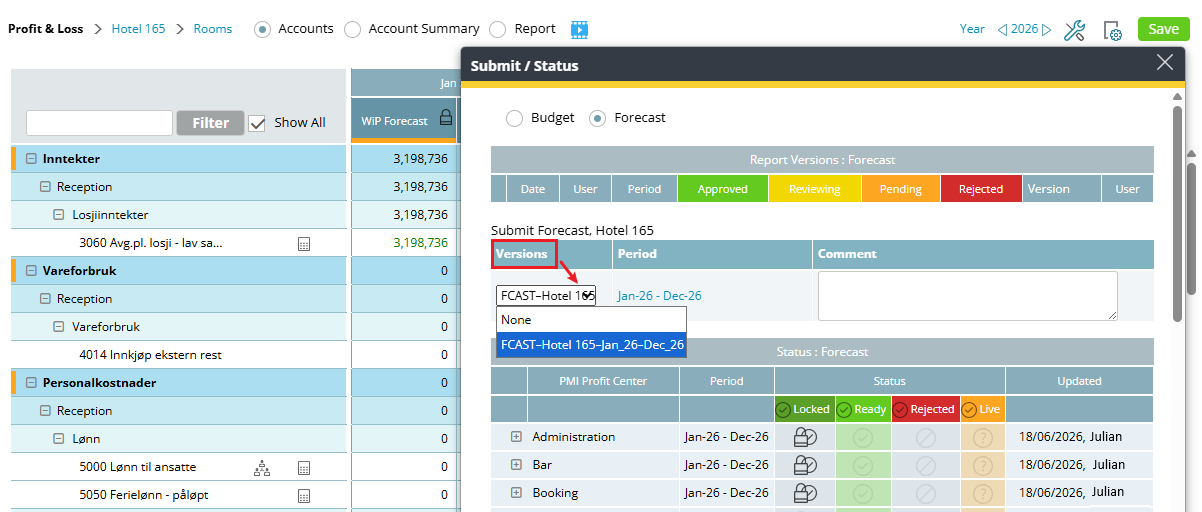
Image description: Example of the version name in P&L Status
1. How future cycles are calculated
What it does
Once you set up your first cycle, called the anchor, the system figures out all the future cycles automatically by shifting every anchor date forward by the same amount, based on your repeat setting.
How it works:
- Annually – Every date shifts forward by 12 months.
- Quarterly – Every date shifts forward by 3 months.
- Monthly – Every date shifts forward by 1 month.
This shift applies to all dates in the anchor cycle:
- Planning period start date
- Planning period end date
- Team submission window open date
- Team submission window close date
- Final review deadline
Note: All dates move forward together by the same amount.
Worked example
Your anchor budget cycle:
- Planning period – Jan 2027 to Dec 2027
- Team window opens – 19 Aug 2026
- Team window closes – 19 Nov 2026
- Review deadline – 30 Nov 2026
- Repeat – Annually
- Planning period: jan 2027 – dec 2027
- Team window opens: 19 aug 2026
- Team window closes: 19 nov 2026
- Your review deadline: 30 nov 2026
PMI generates the following cycles:
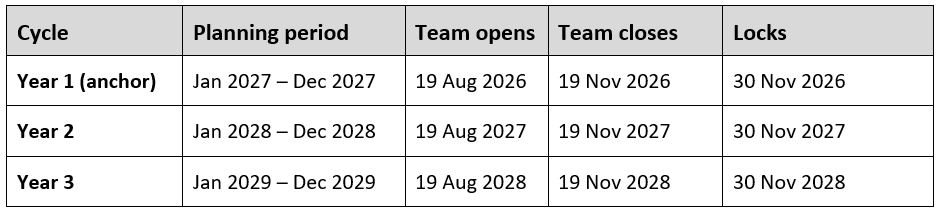
You set it up once. The system fills in the rest.
Edge case: Months shorter than 31 days
If a date falls on the 31st and the target month does not contain a 31st day, PMI automatically uses the last day of that month instead.
For example:
- March 31 → June 30
- June 30 → September 30
- September 30 → December 31
This ensures every generated date remains a valid calendar date.
2. Date rules enforced by the system
What it does
PMI prevents invalid or conflicting schedules from being saved. These checks happen in real time, and invalid dates are unavailable for selection in the date picker.
Rule 1 — Chronological order
The team submission window must open before it closes.
The close date must always be later than the open date.
Rule 2 — Review window must follow the team deadline
The final review deadline must be the same as or later than the team submission deadline.
A planning cycle cannot be locked before users have finished submitting data.
Rule 3 — No anchors in the past
The first cycle’s lock date must be today or in the future.
You cannot create a new automated schedule that begins in the past.
Rule 4 — Cycles can’t overlap
The total time between the team open date and the review lock date must be shorter than the selected repeat interval.
For example:
- A cycle that remains open for 120 days cannot repeat quarterly.
- Quarterly cycles repeat every 90 days.
- The next cycle would begin before the current cycle is completed.
PMI prevents this configuration from being saved.
3. How version names are built
What it does
When PMI creates a plan version, it generates the version name using the naming template configured in Cycle schedule.
The version name is fixed at the moment the version is created and never changes.
The building blocks:
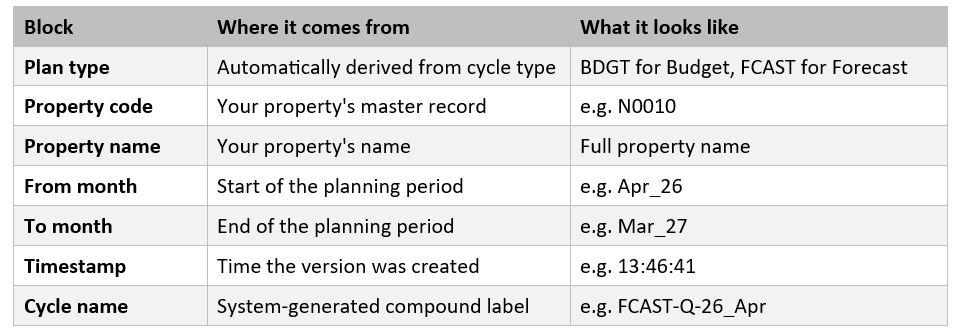
How the cycle name is generated
The cycle name is assembled using:
[Plan type] – [Repeat abbreviation] – [Last two digits of year] _ [Start month abbreviation]
Repeat abbreviations:
- A = Annually
- Q = Quarterly
- M = Monthly
Example: A quarterly forecast starting April 2026 becomes:
FCAST-Q-26_Apr
Separator cleanup
If you remove a building block from your naming template, PMI automatically removes any unnecessary separators.
Generated named never:
- Start with a separator
- End with a separator
- Contain duplicate separators
Worked example:
Template you configured: [Plan type] + [Property code] + [From month] + [To month]
Version data at creation:
- Plan type = FCAST
- Property code = N0010
- From month = Apr_26
- To month = Mar_27
Generated version name:
FCAST_N0010_Apr_26_Mar_27
This name remains permanently attached to the version.
Updating the naming template later does not rename existing versions.
4. What triggers a version to open
What it does
Every night at midnight, based on the property’s local time zone, PMI checks the planning schedule.
If the current date matches the open date of a scheduled cycle, PMI automatically:
- Creates the plan version
- Generates the version name
- Creates the planning document
- Makes the version available to users
What happens if the creation fails
If version creation fails because of a temporary system issue, PMI does not skip the cycle.
Instead, PMI:
- Retries after one hour
- Retries again after two hours
- Retries a final time after three hours
If all retry attempts fail, a critical alert is sent to the designated system administrator for investigation.
The cycle does not disappear — someone will be notified to investigate.
5. How the system handles rule changes mid-cycle
What it does
When schedule rules are changed while a cycle is already open, PMI uses a defined priority order to determine how the changes should be applied.
This helps prevent unexpected deadline changes for users who are already working in the cycle.
Scenario A — you changed the master rules only
Example:
You extended next year’s budget submission window from 60 days to 90 days, but this year’s budget is already open.
PMI asks you to choose between:
- Future cycles only — This year’s budget carries on under its original deadline. Next year’s budget gets the new 90-day window.
- Immediately — This year’s budget deadline updates right now.
Budget rule changes only affect budget cycles. Changing forecast rules never touches an open budget cycle, and vice versa.
Scenario B — you adjusted a specific cycle’s dates directly on the schedule
Example:
You shifted the close date for the April forecast cycle by two weeks to avoid a public holiday.
PMI confirms that:
- The change applies only to the selected cycle.
- All other cycles continue to follow the master rules
Scenario C — you changed the master rules and directly edited the same open cycle
Example:
You change the forecast cadence globally and manually adjust the dates of the currently active forecast cycle.
PMI applies the changes as follows:
- The manual date adjustment takes priority for the active cycle.
- The master rule is ignored for the currently open cycle
- The master rule changes apply to future cycles.
- Only one confirmation prompt is displayed.
6. Rules that protect your historical data
Old plans are never touched
Automation rules apply only to plan versions created after you first activate the schedule.
Existing versions remain unchanged regardless of:
- Creation date
- Naming format
- Planning schedule
Naming changes don’t rename existing versions
Changes to the naming template apply only to future versions.
Previously created versions keep their original names.
Locked versions cannot be reopened
Once a version reaches the Locked status, no configuration change can reopen it.
This includes changes to review deadlines or scheduling rules.
Edge cases
Re-enabling a disabled plan type
If forecasting or budgeting was previously disabled and is later re-enabled, all date fields are cleared.
PMI requires a new anchor cycle to be configured before future cycles can be generated.
This prevents outdated dates from becoming the basis for future planning schedules.
Turning off a plan type while a cycle is open “kill switch”
If budgeting or forecasting is disabled while a cycle is currently open, PMI displays a confirmation prompt before saving.
The active cycle continues normally until completion.
No future cycles of that type will be generated.
Running budget and forecast cycles simultaneously
Budget and forecast cycles operate independently.
This means:
- Budget and forecast cycles can overlap.
- Rule changes apply only to the affected plan type.
- Confirmation prompts apply only to the affected plan type.
- Locking one plan type does not affect the other.
Related articles
Plan version automation – Never miss budget season
How to set up automated planning cycles
- budget
- budget and forecast
- Budget Cycles Forecast Cycles Submission Windows Review Deadlines Planning Rules Schedule Automation Financial Planning Workflow Automation Budget Management Forecast Management
- Budget Planning
- Cycle Scheduling
- Forecast Planning
- p&l planning
- Plan Versions
- planning
- Planning Automation
- Planning Cycles
- Version Naming
-
Getting started
-
-
- Arrivals/Departures
- Data elements required from PMS
- Manual Export PMS – Fidelio
- How to do a manual PMS export from Opera
- Manual Export PMS – Picasso
- Manual Export PMS – Protel
- Manual Export PMS – Spirit Web
- PMS – Cenium
- PMS – Citybreak
- PMS – Fidelio
- PMS – Opera
- PMS – Protel
- How to do a manual PMS export from HotSoft
- PMS – Skidata
- How to set up an Opera reports export
- PMI API
- PMI API Best Practice Get Forecasted hours
- PMI File Agent setup and documentation
- Technical specification for data integration
- How to transfer data to PMI
- How to enable Opera Cloud reports
- PMI system integration overview
- Opera Scheduler setup - Reservation Statistics 1
- Opera Scheduler setup - Report Trial Balance (trial_balance)
- Opera Scheduler setup - Reservation Forecast, (res_forecast)
- Opera Scheduler setup - Reservation History & Forecast (history_forecast)
- Opera Scheduler setup - Daily Forecast Report
- Opera Scheduler setup - SFTP transfer guide
- Manual Export PMS Opera
- Report 1 (manual export): Reservation Statistics 1 (res_statistics1)
- Report 2 (manual export): Reservation Forecast, (res_forecast)
- Report 3 (manual export): Trial Balance (trial_balance)
- Report 4 (manual export): Reservation History & Forecast (history_forecast)
- Show all articles ( 4 ) Collapse Articles
-
- Understanding Productivity in Hospitality (and Why It Matters in PMI)
- How Forecasting Drives Productivity in Hotels
- The Most Important Productivity KPIs in Hospitality
- The Hotel Productivity Management Cycle
- Hospitality Productivity and PMI – Quick overview
- Balancing Productivity, Cost Control, and Guest Service in Hotels
-
Video tutorials
-
- Administration Labor cockpit [14:49]
- Bar and Pub Labor cockpit [12:21]
- Breakfast Labor cockpit [12:05]
- Consolidated view in Benchmarking and Management Perspective [3:20]
- Flash Report Onboarding [6:27]
- Flash report overview [2:25]
- Food cost cockpit [6:21]
- Kitchen Labor cockpit [11:28]
- Labor Cockpit Onboarding [18:16]
- Labor cockpit overview [3:12]
- Live forecast 1/5 navigation [5:05]
- Live Forecast 2/5 Rooms [5:05]
- Live forecast 3/5 meeting & event [5:40]
- Live forecast 4/5 food & beverage [6:11]
- Live forecast 5/5 breakfast [7:19]
- Live forecast onboarding [6:06]
- Live forecast overview [2:58]
- Management perspective overview [3:06]
- P&L Planning 1/10 Purpose and benefits [2:25]
- P&L Planning 10/10 How to approve forecast and budget or target [2:34]
- P&L Planning 2/10 Navigation [4:26]
- P&L Planning 3/10 How to build a total [4:29]
- P&L Planning 4/10 Three ways of inserting figures [4:32]
- P&L Planning 5/10 How to add a sub account [1:42]
- P&L Planning 6/10 How to build a constant [2:42]
- P&L Planning 7/10 Staff module [2:48]
- P&L Planning 8/10 How to add a staff member [1:33]
- P&L Planning 9/10 How to revise and submit a forecast [3:01]
- Repair and Maintenance Labor cockpit [13:01]
- Restaurant Labor cockpit [12:30]
- Schedule 1/8 Navigation [5:12]
- Schedule 2/8 How to create a labor cockpit schedule [4:29]
- Schedule 3/8 How to add a team member [2:07]
- Schedule 4/8 How to create a shift code [3:30]
- Schedule 5/8 How to add shift codes to team members [3:41]
- Schedule 6/8 How to create a rotating schedule [3:20]
- Schedule 7/8 How to replace shift codes for a period [2:00]
- Schedule 8/8 How to create split shifts between departments [2:42]
- Stewarding Labor cockpit [11:38]
- Timesheet Onboarding [4:14]
- Show all articles ( 25 ) Collapse Articles
-
- Articles coming soon
-
- Administration Labor cockpit [14:49]
- Bar and Pub Labor cockpit [12:21]
- Breakfast Labor cockpit [12:05]
- Food cost cockpit [6:21]
- Front office Labor cockpit [12:05]
- Housekeeping Labor cockpit [11:20]
- Kitchen Labor cockpit [11:28]
- Labor Cockpit Onboarding [18:16]
- Labor cockpit overview [3:12]
- Repair and Maintenance Labor cockpit [13:01]
- Restaurant Labor cockpit [12:30]
- Schedule 1/8 Navigation [5:12]
- Schedule 2/8 How to create a labor cockpit schedule [4:29]
- Schedule 3/8 How to add a team member [2:07]
- Schedule 4/8 How to create a shift code [3:30]
- Schedule 5/8 How to add shift codes to team members [3:41]
- Schedule 6/8 How to create a rotating schedule [3:20]
- Schedule 7/8 How to replace shift codes for a period [2:00]
- Schedule 8/8 How to create split shifts between departments [2:42]
- Stewarding Labor cockpit [11:38]
- Timesheet Onboarding [4:14]
- Show all articles ( 6 ) Collapse Articles
-
- How to edit a plan [3:52]
- P&L Planning 1/10 Purpose and benefits [2:25]
- P&L Planning 10/10 How to approve forecast and budget or target [2:34]
- P&L Planning 2/10 Navigation [4:26]
- P&L Planning 3/10 How to build a total [4:29]
- P&L Planning 4/10 Three ways of inserting figures [4:32]
- P&L Planning 5/10 How to add a sub account [1:42]
- P&L Planning 6/10 How to build a constant [2:42]
- P&L Planning 7/10 Staff module [2:48]
- P&L Planning 8/10 How to add a staff member [1:33]
- P&L Planning 9/10 How to revise and submit a forecast [3:01]
-
- Articles coming soon
-
-
Onboarding
-
- Onboarding roles overview
- Onboarding roles – Breakfast
- Onboarding roles – Finance
- Onboarding roles – Food cost
- Onboarding roles – Front Office
- Onboarding roles – Housekeeping
- Onboarding roles – Kitchen
- Onboarding roles – Restaurant and Meeting & Event
- Onboarding roles – Stewarding
- Onboarding roles – Repair and Maintenance
- GM Introduction to PMI
- Onboarding roles – Bar and Pub
- Onboarding roles – Administration
-
-
GM's corner
-
PMI homepage
-
PMI planning
-
- How to work with Rooms Budget and forecast
- How to work with non-rooms Budget and forecast
- Use Forecast/Budget hours from Cockpit in P&L Staff module
- How to input a budget in PMI
- Setting productivity targets in PMI
- Express planner overview
- How to run Express planner
- How to configure Express planner settings
- Express planner calculation explanation with examples
- Compiling revenue streams overview
- How to manually enter a revenue budget in PMI
- How to enter a revenue budget in PMI using Live forecast data
- How to enter a revenue budget in PMI using the Data Upload Centre
- How to set monthly labor productivity and hour targets in PMI
- Arrivals, departures, and stay over visibility
- P&L planning automation - how the system calculates your planning schedule
- Plan version automation - Never miss budget season again
- How to set up automated planning cycles
- Show all articles ( 3 ) Collapse Articles
-
- Room revenue Planning: Calculations explanation
- Labor planning: How to edit
- Overview of GoGreen Planning
- How to set up GoGreen planning for a chain or property
- Navigation and filters in NextGen planning page: explanation with examples
- Sense check mode in new planning pages explained
- How to edit a GoGreen plan
-
- Accounts overview
- How to populate and edit accounts
- How to approve a forecast or budget in PMI
- How to copy from reference
- How to edit and update using the staffing tool
- How to make a profit forecast
- How to set up a weekly Live forecast
- How to add a comparison year in P&L
- How to modify a P&L report
- Planning Menu – Tools and View Options overview
- Planning staff module overview
- How to build a P&L planning report
- How to add staff and manage staff cost
- Staffing screen overview
- How to input a budget in PMI
- PMI Planning module overview
- How to add a Food & beverage revenue forecast in P&L Planning
- How to add room revenue in Planning
- Constants explained: how they work in PMI Planning
- Auto-populate P&L Staff hours and rates from Budget & forecast
- Profit & Loss staff – Copy hours and rates to cockpit
- Show all articles ( 6 ) Collapse Articles
-
-
Cockpit
-
- Labor cockpit overview
- Labor Cockpit Preparations
- Labor cockpit cost driver
- SMART forecast explained
- How does SMART allocate daily hours?
- Using arrivals and departures as a cost driver
- Closing Profit Center or Cockpit
- How to work with labor cost
- Min/Max explanation
- Parent and sub-cockpits explained
- Staffing guide explained
- Daily and weekly routines for department heads
- Understanding the importance of including outsourced labor hours in PMI
- How to add labor cost in PMI
- Cockpit rates - Daily weighted payroll projection
-
- Labor cockpit schedule
- How to make a schedule
- How to revise a schedule
- PMI Schedule: Information and Calculation rows explained
- Predefined shift codes
- How to print a schedule
- Revise staff
- Schedule 1/8 Navigation [5:12]
- Schedule 2/8 How to create a labor cockpit schedule [4:29]
- Schedule 3/8 How to add a team member [2:07]
- Schedule 4/8 How to create a shift code [3:30]
- Schedule 5/8 How to add shift codes to team members [3:41]
- Schedule 6/8 How to create a rotating schedule [3:20]
- Schedule 7/8 How to replace shift codes for a period [2:00]
- Schedule 8/8 How to create split shifts between departments [2:42]
- How to work with the Schedule in PMI
- Split Shifts Between Departments
- The Schedule Tools & View menu options overview
- Show all articles ( 3 ) Collapse Articles
-
-
Live forecast
- Live forecast overview
- How to set up a Live forecast: configuration settings
- Live forecast tools and personal view settings
- PMI prediction explained
- Pickup explanation
- Revenue driver explained
- Segment OTB
- Submit Live Forecast to Forecast (monthly routine)
- NextGen Rooms Live forecast overview
- NextGen Rooms Live forecast: Weekly routine overview
- Rooms live forecast: How to work with auto Live forecast
- NextGen Rooms live forecast: Personal view options
- Rooms Live forecast: Sense check mode explained
- How pickup fields are displayed and used in Room live forecast
- Collaborative Forecasting with PMI Prediction
- Non-rooms Live forecast using PMI prediction
- Live forecast – Copy to live forecast
- Live forecast – Revise forecast/budget
- Rooms Live forecast - Edit guest nights factor explained
- Live forecast settings - Configure food revenue by segment
- Show all articles ( 5 ) Collapse Articles
-
Data analysis views
-
Administration
-
- Add documents to a property
- Currency settings
- Fact sheets overview
- Group external hotel
- How to use hours transfer [3:34]
- Hours transfer rules
- Operational status
- Period locking overview
- Share group
- Share hotel
- How to complete Classification Fact sheet
- How to use Period locking for R&P in practice
- How to manage GoGreen Period locking
-
- How to view imported data in the Import status
- Import status overview
- How to read the Import status page
- Handling Outstanding Imports (Missing Data) in PMI
- Understanding the Import status settings
- Import status - Understanding advanced Data offset validation for GoGreen and Food Purchase interfaces
- Import status - Understanding statuses
- How to reload an API import
-
-
GoGreen
-
- Introduction to GoGreen planning
- Overview of GoGreen Planning
- GoGreen plan values explained
- GoGreen planning charts explained: using charts to understand my forecast
- How to set up GoGreen planning for a chain or property
- How to do a GoGreen monthly forecast routine
- Navigation and filters in NextGen planning page: explanation with examples
- Data table general explained
- Sense check mode in new planning pages explained
- How to edit a GoGreen plan
- GoGreen home page overview
- GoGreen Doing Cockpit overview
- GoGreen Learning page overview
- GoGreen index overview
- Weather normalization overview
- CO2 factors overview
- GoGreen targets explanation
- GoGreen index: How are the measurements calculated?
- Useful links for sustainability and environmental management best practice
- How to make a manual entry in a GoGreen cockpit
- Weather normalization explained
- GoGreen benchmarking enhancement - 01.23
- GoGreen – Data Integration & Insights (Overview)
- Environmental Sustainability in Hotels – Foundation
- Environmental Dimensions in Hotel Operations (Energy, Water, Waste, Emissions, etc.)
- Environmental Management Systems (EMS) in Hotels
- GoGreen Monitoring, Measurement, and Performance Evaluation in Hotels
- Waste Measurement and Verification in Hotels
- Emergency Preparedness and Environmental Risk Management in Hotels
- Hotel Water Consumption Profile & Key KPIs
- Domestic Hot Water Systems in Hotels (Efficiency & Legionella Control)
- Cooling Towers and Water Efficiency in Hotel HVAC Systems
- Water Metering, Submetering and Leak Detection in Hotels
- Preventive Water Management Tasks for Hotels
- Nordic Swan Ecolabel for Hotels
- How the Nordic Swan Criteria and Scoring Work
- BREEAM Certification for Hotels Explained
- Green Key Certification for Hotels
- Hotel Energy Consumption and Key Performance Indicators
- Hotel Energy Benchmarking (A++–G Classification)
- HVAC Systems and Energy Optimization in Hotels
- Boiler Systems and Heating Efficiency in Hotels
- Building Management Systems (BMS) and Energy Monitoring
- Preventive Energy Management and Engineering Tasks
- GoGreen Sustainability Knowledge Hub
- Advanced Water Optimization in Hotels
- Smart Leak Detection in Hotels
- Smartvatten Leak Alarms for Hotels
- How to Investigate Water Leaks in a Hotel
- Water Balance Modeling and Water Analytics for Hotels
- Smart Irrigation and Cooling Tower Water Optimization in Hotels
- Hotel Water Management and Optimization – Overview
- How to Control Linen Inventory in Hotels
- How to Set Up a Food Waste Management Program in Hotels
- How to Run a Food Waste Audit in Hotels
- Food Waste Troubleshooting and Best Practices for Hotels
- PMI Energy Heatmap – Understanding Energy Consumption Patterns
- How to Control Your Hotel Using Data and Operational Discipline
- PMI GoGreen Cockpit – Managing Sustainability Performance in Hotels
- How to Set Up GoGreen in PMI
- How to Measure and Manage Waste in Hotels
- GSTC Hotel Standard – What It Is and How It Applies to Hotels
- Green Key Certification for Hotels – What It Is and How It Works
- Sustainability Certifications for Hotels – GSTC, Green Key, Nordic Swan, and BREEAM
- GoGreen in PMI – Sustainability and Operational Efficiency in Hotels
- PMI GoGreen Knowledge Hub
- Hotel Energy Benchmark – Energy Analysis Reference
- Hotel Energy Optimization – Understanding Base Load, Peaks, and Energy Performance
- Hotel Energy KPIs Explained: Base Load, Peak Demand, and Key Metrics
- How to Analyze Hotel Energy Consumption Patterns
- How to Identify Energy Savings Opportunities in Hotels
- Green Key Certification in Hotels – Overview and Practical Application
- Green Key Criteria – Mandatory and Optional Tasks (Pre-defined)
- Show all articles ( 48 ) Collapse Articles
-
-
KPIs
-
PMI adoption index
-
General user knowledge
-
Miscellaneous
-
Access system
- Articles coming soon
-
FAQ
-
- How can I see the hours that are imported to PMI?
- How do I enter the rates?
- How do I know if I am scheduling according to activity?
- How does PMI summarize the hours?
- How is productivity calculated?
- What are fixed hours?
- What are productive and non-productive hours?
- What are the rates and how are they calculated?
- What is a cost driver?
- What is min/max hours?
- Why do the planned hours in the Timekeeping System (TKS) not match PMI?
- Why is the total number of hours for the month too low/high?
- What is SMART?
- How F&B departments can set realistic targets when room revenue drops temporarily
- Why is my MTD SMART productivity different from my ME SMART productivity when my cockpit is locked on Productivity?
-
- How do I estimate my Closing Inventory?
- My food cost % is wrong (too high/low). Why is that?
- My turnover days are set to 32. What does that mean?
- What are my routines in the Food cost cockpit?
- What do I enter in the Purchase column?
- What is opening and closing stock?
- What is the recommended number of turnover days?
- What is turnover days and how is it calculated?
- Where do I change my food cost forecast?
- Why is opening and closing stock important?
-
- Can one employee work in two departments?
- How do I add a shift code?
- How do I copy hours into the unspecified row (Timekeeping system excluded)
- How do I create a rotating schedule?
- How do I make a new schedule?
- How do I navigate the tools in the schedule?
- What are timekeeping system (TKS) excluded hours for?
- How do I add a schedule to my cockpit?
- Do workers added in the schedule get carried over to future months?
-
- Do I have to change my budget & forecast manually every month?
- How can I see what the current cost driver is?
- How do I set a productivity goal?
- How does the cost driver effect my hours and productivity?
- Where can I find the upload function?
- Why are my budget and forecast locked?
- What is Room revenue planning?
-
- How do I copy to Live forecast?
- How do I submit my Live forecast to forecast?
- How do I reset the pickup for a full month?
- Why do I have a red triangle to the left of the date?
- What are Pickup statistics?
- What are covers?
- What are the seasons in PMI?
- What do the pickups show and why are they sometimes negative?
- What is a revenue driver?
- What is the difference between Forecast and Live forecast?
- Why does on the books in PMI not match what we have in our PMS?
- How do I calculate ARR and ADR?
-
- Can I edit the figures in the Flash report?
- Different view options in the Flash report
- How am I performing compared to my forecast/budget/last year?
- How can I print the report?
- How can I switch between viewing daily and monthly figures?
- How do I check what segments add to the total daily figure?
- How do I edit my covers?
- Why are my room/guest nights wrong?
- What is the Flash Report
- Why is my revenue wrong?
- How is the month-to-date forecast and budget calculated in the Flash report?
- Why are the numbers in the Flash report different from the Live forecast?
- Where can I see account mapping details?
-
- How do I know if the mapping is correct?
- How do I know where accounts should go in PMI?
- How do I map the categories in the timekeeping system (TKS)?
- I cannot see my department in Timekeeping System (TKS) mapping. How do I see it?
- There is a position missing in the Timekeeping system mapping. How can I fix this?
- What are Categories in PMI Timekeeping system?
- What is Departments in Timekeeping system (TKS) mapping?
- What is mapping accounts?
- What is mapping – timekeeping system?
- Why don’t I see the spoon and fork icon in account mapping?
-
PMI Release notes
-
- GoGreen Task Bank and Cockpit enhancements - 12.24
- Refrigerants and Fuel Tracking for GoGreen cockpits enhancement - 11.24
- KPI targets enhancement - 10.24
- Automatic renewal of constants enhancement - 10.24
- GoGreen manual entry enhancement - 10.24
- CO2 factors enhancement - 09.24
- KPI targets enhancement - 07.24
- NextGen Rooms Live forecast statistics and pickup data enhancement - 07.24
- Date picker enhancement - 07.24
- Update to NextGen Rooms Live forecast - 06.24
- P&L planning accounts enhancement - 06.24
- Weather normalization enhancement - 05.24
- Update to NextGen Rooms Live forecast page: Sense check updates - 05.24
- PMI adoption index enhancement - 05.24
- PMI adoption index enhancements - April 2024
- Consolidation OTB enhancement - April 2024
- Update to NextGen Rooms live forecast page: Personal view options, Mar 2024
- User administration enhancements March 2024
- GM daily digest enhancement March 2024
- PMI Index calculation updates for 2024
- KPI targets enhancement February 2024
- KPI targets enhancement - January 2024
- Show all articles ( 7 ) Collapse Articles
-
- GoGreen benchmarking enhancement - 01.23
- GoGreen index calculation enhancement - 04.23
- PMI adoption index: Help videos for measurements enhancement - 02.23
- Activity log enhancement - 07.23
- Arrivals and departures forecast enhancement - 02.23
- KPI upload tool enhancement - 08.23
- GoGreen Food waste cockpit enhancement - 08.23
- GoGreen Doing cockpit enhancement - 06.23
- Benchmarking: PMI Index value updates based on time period selected - 06.23
- GoGreen cockpit: Highlight months missing data on 12 month graph - 07.23
- KPI targets enhancement - 01.23
- Goal distribution tool enhancement - 09.23
- Live forecast enhancement: Editing ARR values -12.23
- User administration release note - 12.23
- New page view of Rooms live forecast - 12.23
-
- Benchmarking calculation enhancement - 03.22
- Enhancement to add department type in the P&L report - 03.22
- Print all unmapped accounts on chain level - 03.22
- Printing to Excel and PDF enhancement - 03.22
- Introduction to PMI enhancement
- Room Live forecast – Change to pickup fields - 04.22
- Information/calculation rows in PMI schedule - 09.22
- Export to Google Sheets enhancement - 08.22
- PMI Advanced settings – Period locking - 06.22
- GM daily digest enhancements - 09.22
- PMI adoption index: Option to filter and export scores enhancement - 12.22
- Profit center Live forecast: Automatically switch between OTB and revenue driver
- SMART Forecast enhancement - 09.22
-
d2o team only
-
- Articles coming soon
-
- Articles coming soon
-
- Articles coming soon
-
- Articles coming soon
-